Onward Ticket for Dubai & UAE 2026: What Gets Checked at DXB Airport
Your onward ticket for Dubai gets checked three separate times before you ever see the UAE skyline — and most travelers only know about one of them. The airline checks it at check-in before you board. UAE immigration checks it when you land. And if you applied for an e-visa in advance, the visa portal may have checked it at application stage too. Miss any one of those three checkpoints and you're either denied boarding, held at immigration, or deported at your own expense.
This guide covers everything: what counts as valid proof of onward travel in Dubai, how transit rules differ from tourist visa rules, which terminal your airline uses at DXB, how Emirates handles it differently from flydubai or Air Arabia, and what changed in December 2025 that means you no longer need to do a "visa run."
Need proof of onward travel fast? Get an instant flight reservation with a real PNR — accepted for Dubai e-visa applications and airline check-in. Get your Dubai onward ticket → ticket-dummy.com
Does Dubai Actually Require an Onward Ticket?
Yes — and it's not just a formality. The UAE onward ticket requirement is stated clearly by the UAE Embassy, the official u.ae government portal, VFS Global, and every UAE airline's conditions of carriage. Here's the official language: "A confirmed round-trip airline ticket or airline ticket to another destination" is required.
What that means in practice:
- You need a confirmed ticket showing you're leaving the UAE before your visa expires.
- "Confirmed" means a real booking with a PNR (booking reference) that can be verified in the airline's system.
- Open-jaw routes count — you can arrive into DXB and depart from AUH or SHJ on the same trip.
- An open-ended or "standby" ticket doesn't count.
The requirement applies whether you're entering on a visa on arrival, a pre-arranged 30-day e-visa, or a 60-day tourist visa. The only people who can skip it are UAE residents re-entering on their residence permit.
The Three Checkpoints: Where Your Onward Ticket Gets Verified
Checkpoint 1 — Airline Check-In at Your Origin Airport
This is where most denials happen, and most travelers don't expect it. The airline flying you to Dubai is legally liable if UAE immigration turns you away on arrival. That means airlines check your onward ticket before you board — at the check-in counter and sometimes again at the gate.
Emirates, flydubai, Air Arabia, and Etihad all apply this check. If you're flying a third-party carrier into Dubai (say, Lufthansa or Turkish Airlines), they follow the same rule — they don't want to pay to fly you home.
What they want to see: a printed or digital confirmation with your name, flight number, departure date, and a PNR they can verify.
Checkpoint 2 — UAE Immigration on Arrival
Even if you cleared check-in at home, UAE immigration at DXB, AUH, or SHJ will ask for proof of onward travel in Dubai if they want to see it. Officers at the border can request any entry document — passport, hotel booking, return flight, proof of funds. Not every passenger gets the full inspection, but it happens routinely, especially for:
- First-time visitors
- Passport holders from high-scrutiny countries
- Travelers arriving without a pre-arranged visa
- Anyone whose entry purpose looks unclear
If immigration isn't satisfied, the consequences are serious: you can be held in a waiting area, questioned for hours, required to purchase a ticket on the spot (at inflated airport prices), or refused entry entirely. The airline that brought you is responsible for flying you home — and they will bill you for it.
Checkpoint 3 — The UAE e-Visa Application Portal
If you're applying for a Dubai e-visa before travel (through the ICP portal, a travel agent, or a service like VFS Global), the application checklist includes: "Confirmed return/onward ticket."
Some portals technically accept "provisional" booking details at the application stage — meaning a flight reservation with a PNR rather than a paid ticket. But by the time you're actually traveling, that reservation needs to still be valid. If you used a hold booking that expired, you're at checkpoint 1 and 2 with nothing to show.
Tourist Visa vs Transit Visa: Different Rules, Different Stakes
Tourist & Visit Visa Requirements
For a standard Dubai tourist visit, you need a confirmed onward or return ticket. The ticket must show departure from a UAE airport (DXB, AUH, or SHJ) within your visa validity period — 30 or 60 days from entry.
What works:
- A fully paid return flight to your home country
- A one-way ticket to any third country (onward, not return)
- An open-jaw itinerary (fly in to DXB, fly out from AUH)
- A fully refundable ticket booked and later cancelled after entry
- A legitimate flight reservation from a real airline system (some acceptable at e-visa application stage)
What doesn't work:
- A screenshot of a search result or price comparison
- A ticket on an airline that doesn't exist or doesn't fly that route
- An expired hold booking
- Open-ended / no-date tickets
Transit Visa Requirements (48-hour and 96-hour)
Transit visa rules are stricter — no exceptions. If you want to leave the airport during a layover at DXB or AUH (go to your hotel, explore the city, stay overnight), you need a UAE transit visa. And that transit visa is specifically issued around your connecting flight schedule.
Here's how it works:
- Transit visas are sponsored by the UAE airline you're traveling on — Emirates (for DXB) or Etihad (for AUH)
- You apply on the airline's website before your trip
- You must provide a confirmed onward booking departing Dubai within 48 or 96 hours
- 48-hour transit visa: approximately USD 10 | 96-hour: approximately USD 49
- These visas are non-extendable and single-entry
- No confirmed onward ticket = no transit visa. Full stop.
If you're transiting airside (staying inside the secure zone without exiting), you don't need a transit visa — but the airline at your origin will still check that you have an onward flight before they let you board.
| Scenario | Onward Ticket Required? | Strictness |
|---|---|---|
| Tourist visa on arrival | YES — confirmed | High |
| Pre-arranged e-visa tourist | YES at airport (if not at application) | High |
| 48/96-hr transit visa | YES — mandatory, no exceptions | Very High |
| Airside transit, no exit | At airline check-in only | Medium |
| UAE resident re-entering | No (residence permit suffices) | N/A |
Transit through Dubai? You need a confirmed onward booking before your transit visa application can be approved. Get your Dubai onward ticket → ticket-dummy.com
Airline Policies for Dubai Onward Tickets
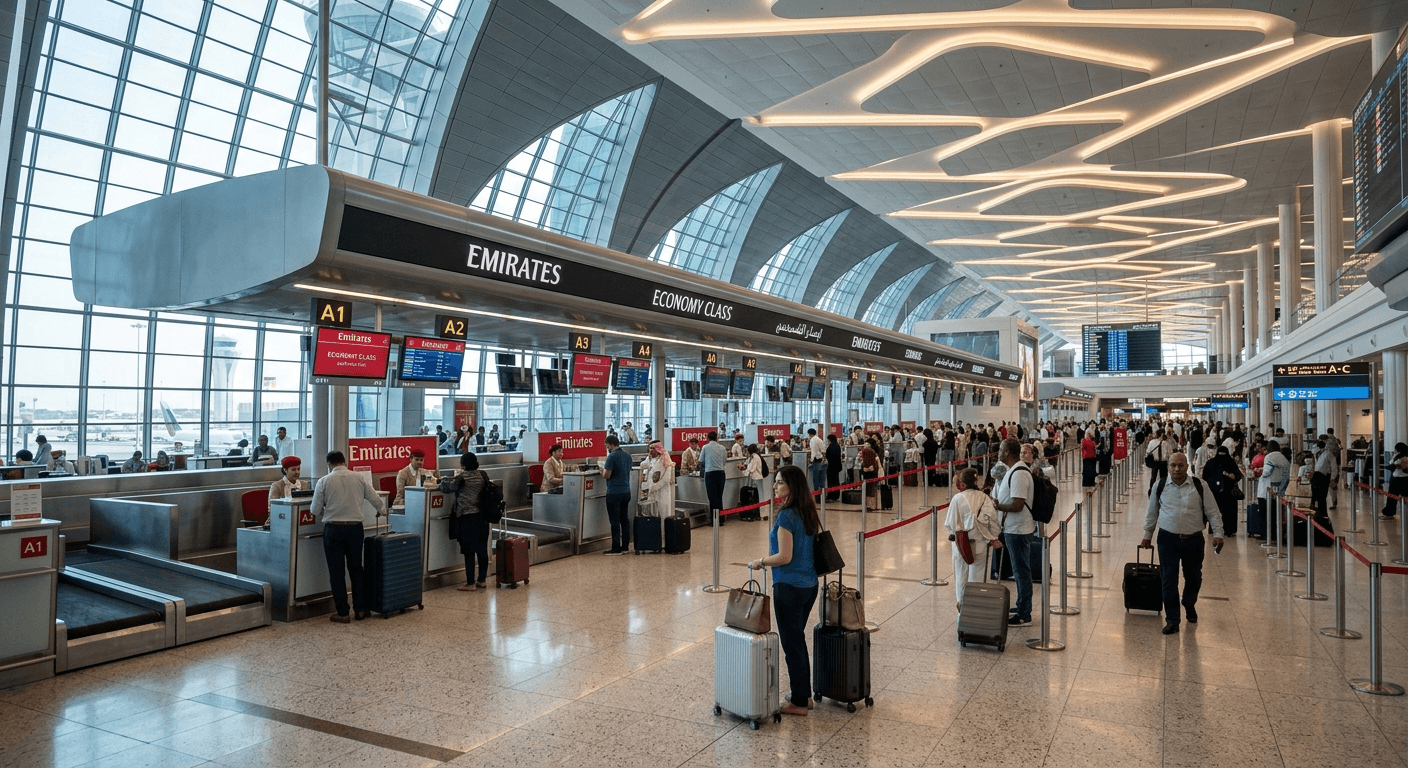
Emirates (Terminal 3, DXB)
Emirates operates exclusively from Terminal 3 at Dubai International — the largest terminal at the world's busiest international airport. As the UAE's flag carrier, Emirates applies the most thorough pre-boarding checks.
Emirates staff check onward travel documentation at check-in for all inbound Dubai flights. The airline also sponsors UAE transit visas (48hr and 96hr) through its own portal — and those applications require a confirmed onward booking as part of the submission.
One practical note: if you have a combined Emirates + flydubai itinerary (the two airlines are partners), your baggage can be tagged through and your onward boarding pass issued at the Emirates transfer desk. This is a single-booking experience — much simpler than managing separate tickets.
flydubai (Terminal 2, DXB)
flydubai is a budget carrier and operates from Terminal 2 at DXB. It doesn't publish a standalone "onward ticket check" policy, but its conditions of carriage make clear that unused reservation coupons (missed check-ins) cancel all remaining reservations on the booking. More importantly, passengers arriving at DXB on flydubai go through the same UAE immigration as everyone else — same rules apply.
If you're connecting to a flydubai flight from an Emirates flight (or vice versa), the partner transfer desk at T2 handles the boarding pass. If you've booked the legs separately, you'll need to clear passport control, collect your bags, and re-check in.
Air Arabia (Sharjah Airport, SHJ — and AUH)
Air Arabia is the UAE's largest low-cost carrier and mainly operates from Sharjah International Airport (SHJ), with some AUH services. Here's something worth knowing: Sharjah Airport is technically in the emirate of Sharjah, not Dubai — but it's about 15–20 km from central Dubai and frequently used by Dubai-bound travelers on a budget.
UAE immigration rules are federal — they apply the same way across every UAE airport. Air Arabia passengers landing at SHJ face identical onward ticket requirements to those landing at DXB.
If you're booking a cheap flight and landing at SHJ thinking it's a "Dubai airport," don't be surprised by the full UAE immigration process — you're still entering the UAE and the same dubai airport onward ticket rules apply.
Etihad Airways (Abu Dhabi, AUH)
Etihad operates from Abu Dhabi International Airport. Like Emirates, Etihad sponsors transit visas (48hr and 96hr) for AUH layovers — and those require a confirmed onward booking to a third country. Etihad is explicit in its documentation: "confirmed ticket to Abu Dhabi and onward to a third destination" is required for transit visa approval.
AUH also offers US preclearance, which is a significant convenience for US-bound passengers — you clear US Customs and Border Protection before departure rather than on arrival in the US.
Airport Breakdown: DXB, AUH, and SHJ
Dubai International Airport (DXB)
DXB is the world's busiest airport by international passenger volume. There are three terminals:
- Terminal 1: International airlines (various carriers)
- Terminal 2: flydubai and regional/budget carriers
- Terminal 3: Emirates (all Emirates flights)
Transit between terminals at DXB isn't seamless — it requires a bus or shuttle transfer, and if you're on separate tickets, you need to exit the airside zone, collect bags, and re-check in. If your journey is on a single itinerary across multiple airlines, the transfer process is smoother, but still factor in the distance between terminals.
DXB offers paid Marhaba transfer services if you want hands-on help with transit baggage. The airport is enormous and genuinely confusing on your first visit — allow extra time.
Abu Dhabi International Airport (AUH)
Etihad's home hub. The new Terminal A opened in late 2023, significantly expanding capacity. AUH applies the same UAE federal immigration rules — a confirmed onward ticket is required for tourist entry and transit visa applications. US preclearance is available for US-bound flights.
Sharjah International Airport (SHJ)
Air Arabia's hub. Smaller, less crowded, and often cheaper to fly into than DXB. Commonly used by travelers going to Dubai who want to save money on airfare. Make sure you account for the transfer time from SHJ to central Dubai (taxis, ride-share, or buses). UAE immigration at SHJ follows the same rules as DXB — proof of onward travel in Dubai/UAE is required at the border.
What Changed in December 2025: No More Visa Runs
Before December 4, 2025, travelers who wanted to extend their stay in the UAE often had to do a "visa run" — leaving the country briefly (typically to Oman, Bahrain, or Georgia) and re-entering to get a fresh visa stamp. That loophole is gone.
What changed:
- Visa runs are no longer valid. Re-entering UAE on a new tourist visa from a "border run" trip is no longer accepted as a way to extend your stay.
- In-country extensions are now available. You can extend your tourist or visit visa while still inside the UAE — no need to leave. Applications go through the ICP portal or approved travel agents.
- Maximum stay: 120 days total per visit (for tourist/visit visas with extensions). Overstay fines remain at AED 50 per day.
For onward ticket purposes, this change matters: your onward ticket now needs to genuinely reflect your intended departure date. If you're planning to stay a full 30 days and potentially extend, book your outbound flight for after the initial visa period and apply for an in-country extension if needed. Don't book an onward flight for day 15 if you plan to stay for 50 — immigration will notice the mismatch.
Risks of Fake or Unverifiable Onward Tickets
This section exists because a lot of searches for "dummy ticket dubai" are looking for fake itineraries — screenshots, modified PDFs, or entirely fabricated documents. Let's be direct about the risks.
Airlines and UAE immigration increasingly verify tickets using live access to airline reservation systems (GDS — Global Distribution Systems like Amadeus, Sabre, and Galileo). A ticket that looks real but doesn't appear in the system will be caught. The consequences:
- Denied boarding at origin airport. You don't get on the plane. No refund on accommodation or other bookings.
- Refused entry at UAE immigration. Held, questioned, deported. Airlines must return you at their expense — and they'll recover that cost from you.
- Potential legal consequences. Presenting forged documentation to immigration authorities is a serious offence in the UAE. The UAE has strict fraud laws — penalties include fines and/or imprisonment.
- Airline blacklist. Some carriers flag passengers who present fraudulent documents and deny future travel.
The safest options are: a fully refundable real ticket (book it, use it as proof, cancel after entry), the cheapest real one-way route out of UAE (Dubai–Muscat, Dubai–Bahrain, Dubai–Doha can be very cheap), or a legitimate flight reservation service that holds a real booking in the GDS with a verifiable PNR.
Step-by-Step Guide: Getting Your Onward Ticket for Dubai
- Decide your travel dates. Know when you're entering and when your visa allows you to stay. Book your onward departure before the visa expiry date — with a comfortable buffer.
-
Choose your proof method:
- Option A: Book a real return or onward ticket. This is the cleanest option. If you don't have firm plans, book a fully refundable fare and cancel after entry.
- Option B: Use a legitimate flight reservation service (like ticket-dummy.com) that holds a real booking in the airline system with a valid PNR. This works for e-visa applications and airline check-in.
- Option C: Book the cheapest real outbound flight. Dubai–Muscat on Air Arabia or Oman Air, Dubai–Bahrain, Dubai–Doha — often AED 100–200 one-way. Even if you don't use it, you have real proof.
- If applying for an e-visa: Upload your onward ticket/reservation as part of the ICP or travel agent application. Make sure the reservation is still valid when you travel.
- At origin airport check-in: Have your onward ticket ready — on your phone or printed. The check-in agent will verify it. Make sure your name on the ticket matches your passport.
- At DXB/AUH/SHJ immigration: Keep your onward ticket accessible. If the officer asks for it, have it ready. You may also want hotel booking confirmation and proof of sufficient funds.
- After entry: If you booked a refundable ticket for proof purposes, cancel it within the free cancellation window. If you used a reservation hold, it may have expired by now — check your travel plans.
Don't risk it at check-in. Get a legitimate flight reservation with a real PNR — instant delivery, accepted for Dubai e-visa applications and DXB immigration. Get your Dubai onward ticket → ticket-dummy.com
Related Resources
Wondering which other countries require an onward ticket at immigration? Check the full list of countries that require onward ticket proof at the border.